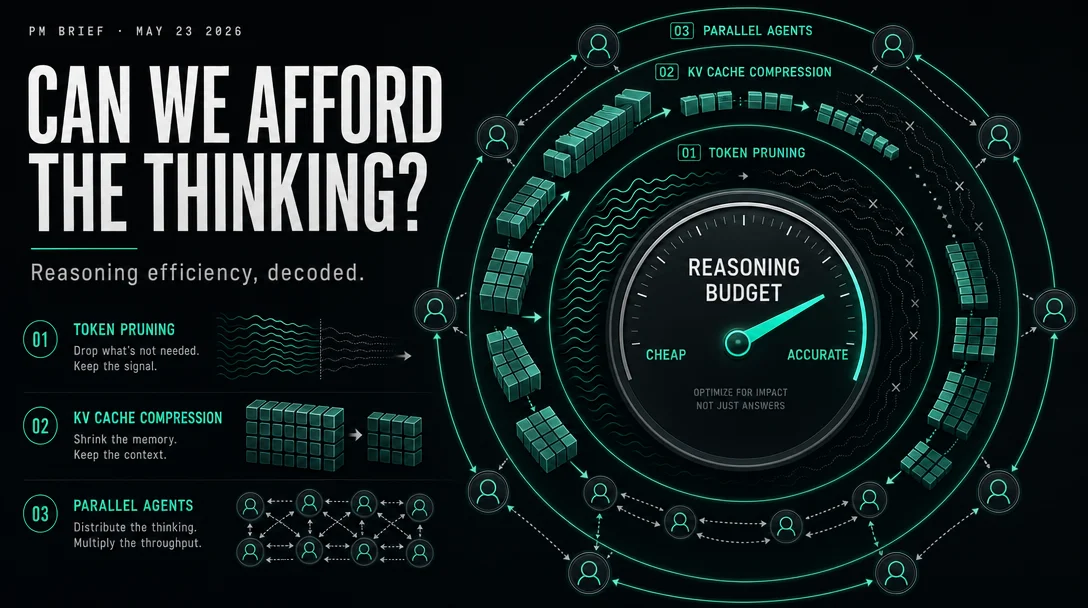

The reasoning bill is coming due

The reasoning bill is coming due

Six arXiv preprints published May 21 converge on the same problem from three independent layers: reasoning models produce bloated, expensive traces — and you can compress each layer (trace content, KV cache, agent idle time) by 20–50% without losing accuracy. Anchored to the Claude Code incident and DeepSeek's permanent price cut, this brief maps all six techniques and closes with three PM decisions for managing reasoning spend before it manages you.

Tech Trend Translator: The PM Brief
May 23, 2026 · 8:26 PM
6 subscriptions · 6 items
Earlier this year, Anthropic quietly introduced a server-side header that trimmed the extended thinking budget inside Claude Code (code-name: redact-thinking-2026-02-12).1 By March 10, 99%+ of thinking tokens were gone. What happened next is the clearest illustration yet of a principle the industry is still absorbing: reasoning budget is a quality lever, not a cost lever. Read-before-edit rates dropped from 6.6× to 2.0×. Blind edits jumped from 6.2% to 33.7%. And API calls went from roughly 1,500 in February to 119,000 in March — an 80× increase.1 As the engineer who documented the incident put it: "A model that thinks deeply and gets it right once is cheaper to serve than one that thinks shallow and retries 10 times."1
The same week DeepSeek made its 75% price cut on V4-Pro permanent — confirming that structural pricing pressure on reasoning APIs is real.23 The question has shifted from "can it reason?" to "can we afford the reasoning?"
Loading link preview…
Six arXiv papers published May 21 answer that directly — from three complementary angles.

Why reasoning traces bloat in the first place

When a model is trained with reinforcement learning to reason, it learns to produce long chains of thought because length correlates with correctness in training. The side effect: production traces fill up with content that adds no accuracy benefit — repeated sub-steps, reasoning segments that circle back on themselves, and continued "exploration" of the problem after the correct answer is already in the chain.4 Researchers from Carnegie Mellon, Northwestern, UNC Chapel Hill, and the University of Pittsburgh call this the "overthinking" problem, and they find that existing efficiency methods (length budgets, length-aware rewards) address the amount of reasoning but leave the quality of what's inside weakly supervised.4
The memory footprint compounds this. Tree-of-Thoughts (ToT; a reasoning approach that explores multiple solution branches before committing) keeps KV cache (key-value states the model stores to avoid recomputing earlier context) alive for every active branch simultaneously. On a single NVIDIA RTX 4090 (24 GB), that creates a hard ceiling on how deep and wide the search can go.5 Meanwhile, agent-based reasoning stacks a third cost on top: the model sits idle during every tool call, burning wall-clock time without producing tokens.6
Three separate cost surfaces. Each one has a published fix as of this week.

Three-layer compression — the technique map

The six papers cluster into three non-overlapping layers of the reasoning stack:
LayerTechniqueWhat it doesMeasured gain
Trace contentCLORE (CMU + Northwestern + UNC + Pitt)External model edits correct rollouts, removes repetition, illegible fragments, and post-answer wandering; optimized via reference-free DPO20–50% length reduction with accuracy improvements on DeepSeek-R1-7B and Qwen2.5-Math-7B 12
Trace contentSearch-E1 (Emory + Kuaishou + Xiamen)Vanilla GRPO + offline self-distillation — no process reward model, no tree search, no hand-crafted bonuses0.440 avg. exact match on 7 QA benchmarks with Qwen2.5-3B, beating all open-source baselines at that scale 13
KV cacheArborKV (USTC + Huawei)Tree-structure-aware eviction: keeps active-branch KV, lazy-rehydrates inactive subtrees for backtracking~4× peak KV memory reduction with near-full-retention accuracy 14
KV cacheMeta-Soft (Guangdong IST + Macau + CUHK-SZ + HKUST)Learnable basis matrix + Gumbel-Softmax selector dynamically synthesizes targeted soft tokens from input features; attention-flow redistribution preserves dropped contextOutperforms SOTA eviction methods on LongBench and RULER 15
Agent executionIdleSpec (KAIST + USC/ISI)Generates speculative plan candidates during tool-call wait time; aggregates them once observations arrive+5.1% on GAIA/FRAMES (general-purpose and long-context agent benchmarks) with Gemini-2.5-Flash; +9.1% Any Medal rate on MLE-Bench (ML competition task benchmark) 16
Agent executionExComm (KAIST + USC/ISI)Parallel agents cross-check each other mid-reasoning; detected factual conflicts trigger a tool-based resolution loop; corrections applied as soft belief updates+5.7% over best baselines on AIME 2024/2025 (math olympiad competition benchmark) and GAIA with Gemini-2.5-Flash-Lite 17
A few things are worth noting about that table. First, CLORE and Search-E1 are additive to each other and to length-budget techniques — CLORE's authors explicitly test it as a plug-in on top of GRPO, DAPO, and ThinkPrune.4 Second, IdleSpec and ExComm come from the same KAIST + USC/ISI group (Jinwoo Shin and Aram Galstyan's labs), suggesting a coordinated program rather than independent parallel discovery.67 Third, all six papers are arXiv preprints — no independent third-party replication yet.
Loading link preview…

What practitioners are already seeing

The research confirms a pattern engineers have been documenting outside the lab.
LangChain jumped 25 places on Terminal Bench 2.0 — from 52.8% to 66.5% — by making four changes, none of which touched model weights: orchestration loop tuning, context management, verification middleware, and reasoning budget adjustment.8 The same weights, substantially better results.
On the deployment layer, llama.cpp now ships --reasoning-budget and --reasoning-budget-message as native parameters, with a known community configuration at --reasoning-budget 4096 --reasoning-format deepseek for Qwen3.6-27B.9 Reasoning cost control has moved from API-layer option to deployment-layer default.
Sebastian Raschka (Lightning AI) observed in mid-May that four major open-source LLM architecture releases in the prior six weeks — Gemma 4 (cross-layer KV sharing), ZAYA1-8B (compressed convolutional attention), Laguna XS.2 (per-layer attention budgets), and DeepSeek V4 (multi-head convolutional + compressed attention) — were all architected around the same constraint.10 "As reasoning models and agent workflows keep more tokens around for longer, KV-cache size, memory traffic, and attention cost quickly become the main constraints."10
Loading link preview…

Three decisions for your PM roadmap

1. Audit your reasoning spend before cutting budget, not after. The Claude Code incident shows that a PM or infra team cutting thinking tokens to save money without first understanding the failure modes will often pay more — in API calls, in retries, in downstream quality issues. Before adjusting any reasoning budget parameter, instrument what changes: read-before-edit ratios, retry rates, task completion quality. Cuts that look like savings on the token line item can be multiplying compute elsewhere.
2. Layer your efficiency investments — trace, cache, and idle time are independent. If your product uses a reasoning model for complex, multi-step workflows, CLORE-style trace compression and ArborKV-style cache eviction are non-competing improvements. You don't have to wait for a single technique to solve everything. A team running Tree-of-Thoughts for search-intensive tasks should look at cache compression first (fastest hardware relief). A team with tool-heavy agent loops should look at idle-time speculation next (IdleSpec-style gains come for free from compute already being paid for).
3. Match your eval setup to where your cost comes from. Task complexity varies within a product — a rename variable ticket and a design retry-loop with backoff ticket should not share a reasoning budget.11 An AI engineer at a consulting firm noted the practical form of this: "budget-per-task means we ship cheap tickets cheap. Take it away and the bill doubles on the rename PRs."11 Segment your eval by task complexity tier, then set independent budgets per tier rather than a single global value.

TL;DR

  • The problem: RL-trained reasoning models produce bloated traces — repetition, illegible fragments, post-answer wandering — that inflate cost without improving accuracy4
  • The research signal (May 21, arXiv): Three independent layers of compression have working techniques — trace editing (20–50% shorter, same or better accuracy), KV cache eviction (~4× memory reduction), and idle-time planning (+5–9% task performance at no extra token cost)456
  • The practitioner warning: Cutting reasoning budget without understanding the failure modes can backfire badly — the Claude Code case saw an 80× API call increase after a 99%+ thinking-token reduction1
  • The move: Instrument first (measure retry rates, quality degradation, per-task token spend). Then layer improvements — trace compression, cache eviction, idle-time speculation are independent, additive gains. Set reasoning budgets per task-complexity tier, not globally
Cover image: AI-generated illustration

References

  1. 1@imsedhu: Claude Code thinking budget silently cut
  2. 2Hacker News: DeepSeek makes the V4 Pro price discount permanent
  3. 3DeepSeek API Pricing
  4. 4arXiv: CLORE: Content-Level Optimization for Reasoning Efficiency
  5. 5arXiv: ArborKV: Structure-Aware KV Cache Management for Scaling Tree-based LLM Reasoning
  6. 6arXiv: IdleSpec: Exploiting Idle Time via Speculative Planning for LLM Agents
  7. 7arXiv: ExComm
  8. 8@gaurav_21s: LangChain +25 spots on Terminal Bench 2.0
  9. 9@verafice: llama.cpp reasoning-budget
  10. 10Sebastian Raschka: Recent Developments in LLM Architectures
  11. 11@fulhadev: reasoning budget per task
  12. 124\|arXiv: CLORE\|https://arxiv.org/abs/2605.22211
  13. 137\|arXiv: Search-E1: Self-Distillation Drives Self-Evolution in Search-Augmented Reasoning\|https://arxiv.org/abs/2605.22511
  14. 145\|arXiv: ArborKV\|https://arxiv.org/abs/2605.22106
  15. 158\|arXiv: Meta-Soft: Leveraging Composable Meta-Tokens for Context-Preserving KV Cache Compression\|https://arxiv.org/abs/2605.22337
  16. 166\|arXiv: IdleSpec\|https://arxiv.org/abs/2605.22154
  17. 179\|arXiv: ExComm: Exploration-Stage Communication for Error-Resilient Agentic Test-Time Scaling\|https://arxiv.org/abs/2605.22102

Add more perspectives or context around this Drop.

  • Sign in to comment.